Am I Anxious or Just Stressed? 7 Anxiety Symptoms You Shouldn’t Ignore | The Therapeutic Space
Am I anxious or just stressed? Learn 7 hidden anxiety symptoms, the difference between stress and anxiety, and when to seek professional support.
7/8/20265 min read
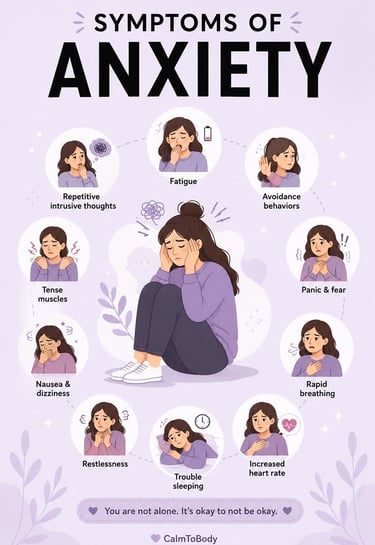
Am I Anxious or Just Stressed? 7 Anxiety Symptoms People Commonly Miss
"I'm just stressed." How many times have you said that and left it at that? In a world that celebrates busyness and pushing through, stress has become the default explanation for almost everything that feels off. Of course you're stressed. You have deadlines, financial pressures, relationship demands and a phone that never stops. Stress is just life, right?
Sometimes, yes. But sometimes what we're calling stress is actually something that deserves a lot more attention.
Stress and Anxiety Are Not the Same Thing
The two feel similar enough that the confusion is understandable. But the difference matters because the way you respond to each one is completely different.
Stress has a source you can point to. A deadline, a conflict, a difficult situation. When that thing resolves, the stress tends to ease with it. Anxiety doesn't work that way. It stays in the body even when nothing is actively wrong. It’s like if the fire alarm keeps going off when there's no fire.
The World Health Organization estimates anxiety disorders affect around 3.6% of the global population, making it one of the most common and most underdiagnosed mental health conditions worldwide. Most people who have it don't know they do, because it doesn't always look like what we imagine anxiety looks like.
7 Anxiety Symptoms That Get Mistaken for Stress
1. You're Exhausted- Even When You've Slept
When your nervous system is running on high alert all the time, it burns through energy even when you're resting. Research published in Brain and Behavior found a strong link between anxiety and chronic fatigue, with anxious individuals reporting persistent tiredness regardless of how much they slept. If rest doesn't restore you, your sleep schedule probably isn't the problem.
2. Your Stomach Is Always Off
Unexplained acidity, nausea, irritable bowel, a constantly unsettled gut- all these are the physical and least recognised symptoms of anxiety. There is real biology behind this. When the nervous system is chronically anxious, it directly disrupts digestion. Studies show that up to 44% of people with anxiety disorders experience significant gastrointestinal symptoms.
3. You Can't Seem to Concentrate
Stress can cause concentration issues but usually when there's a lot happening externally. Anxiety causes this even in calm periods, because your mind is busy scanning for problems, running worst-case scenarios, rehearsing difficult conversations, even when you're not consciously aware of it. A 2019 study in Psychological Medicine found that anxiety significantly impairs working memory and sustained attention, making focus genuinely harder regardless of effort.
4. Your Body Is Physically Tense - For No Clear Reason
Tight shoulders. A clenched jaw at night. Headaches at the forehead or the back of the neck. A general physical tightness that doesn't ease even after rest. Most people attribute this to posture or a bad mattress. But chronic physical tension that keeps returning is often the body holding anxiety. The American Psychological Association identifies muscle tension as one of the most common physical symptoms of anxiety and one of the last things people connect to their mental state.
5. Small Things Feel Disproportionately Big
The traffic makes you unreasonably irritable. A slightly sharp message from your manager sends you into a spiral. Plans changing at the last minute causes genuine panic rather than just a little annoyance. When the nervous system is already worked out by underlying anxiety, it has very little buffer left. Minor irritants hit much harder. People around you might notice you seem unusually sensitive and you might notice it too. This isn't a personality flaw. It's a nervous system running constantly tired.
6. You Keep Imagining Worst-Case Scenarios
Someone doesn't reply and your brain immediately jumps to conclusions- they're angry with me, something terrible happened, I've done something wrong. A quiet period at work and your mind decides- I'm going to lose my job. Some forward-thinking is healthy. But when your brain automatically defaults to the worst possible outcome in most situations, and when that pattern is hard to interrupt even when you recognize it's unlikely- that's anxiety. A lot of research identifies catastrophic thinking as a core feature of anxiety disorders, which is different from the realistic concern-based thinking that comes with ordinary stress.
7. You're Waking Up at 3am With Your Mind Already Racing
Not struggling to fall asleep, but waking in the early hours with your mind already running. Replaying yesterday, worrying about tomorrow, feeling a vague but heavy dread for no clear reason. This is a specific and well-documented anxiety pattern. Cortisol- the body's primary stress hormone- rises naturally in the early morning hours. In people with anxiety, this spike can trigger a wide-awake, high-alert state that feels impossible to come down from. If this is a regular experience, it is worth taking seriously.
"But I Have Real Reasons to Be Stressed"
This is what most people say when they start recognizing these symptoms and it's completely valid. Modern life is genuinely demanding. Stress is real and it deserves acknowledgement.
But here's the key distinction: stress has a clear cause and eases when circumstances change. Anxiety persists, shifts from one thing to the next, shows up in the body, and doesn't resolve even when things are objectively okay. The two can also coexist.
If you've been managing something quietly for months, that itself is worth paying attention to.
What to Do If This Sounds Familiar
Name it honestly. Not "I'm just stressed" if what you're experiencing goes beyond that. Calling it what it is- even just to yourself- is where change begins.
Speak to someone qualified. Anxiety responds well to proper support. There is strong evidence that suggests that approaches like Cognitive Behavioral Therapy, EMDR, Somatic therapies and ACT help in reducing anxiety symptoms and changing the patterns that sustain them.
At The Therapeutic Space, our psychologists work with anxiety, stress, burnout and emotional overwhelm using exactly these approaches. Manvi Sahni, an internationally trained therapist and Somatic EMDR practitioner, specialises in anxiety, overthinking, emotional dysregulation and stress. She has an integrative approach that addresses both the mind and the body. Krisha Gala, a certified narrative and EFIT therapist, supports individuals navigating anxiety, panic, depression and lifestyle-related stress using evidence-based, trauma-informed methods.
Both bring warmth, clinical depth and a non-judgmental approach to every session- whether you're dealing with something you can name clearly or simply a persistent sense that something isn't right.
Don't wait for it to get worse. Anxiety that goes unaddressed doesn't stay the same- it deepens. Early support is significantly more effective than waiting for a crisis point.
You deserve that care. Not eventually. Now.
If this resonated with you, share it with someone who always says they're "just stressed." Sometimes naming it is the first step someone needs. Ready to speak to someone? Explore our therapists at The Therapeutic Space and take the first step toward feeling better.
The Therapeutic Space © 2025. All rights reserved.
We care deeply for your mental health, but The Therapeutic Space does not provide emergency or crisis support.
If you or someone you know is in immediate danger or requires urgent help, please contact the national mental health helpline at 1800-599-0019, reach out to suicide helplines, or visit your nearest hospital or emergency center for immediate assistance.