Why Am I Always Overthinking Everything? Causes, Signs & Solutions | The Therapeutic Space
Always overthinking? Learn why your brain spirals, common causes of overthinking, and practical strategies to manage racing thoughts and anxiety.
7/8/20265 min read
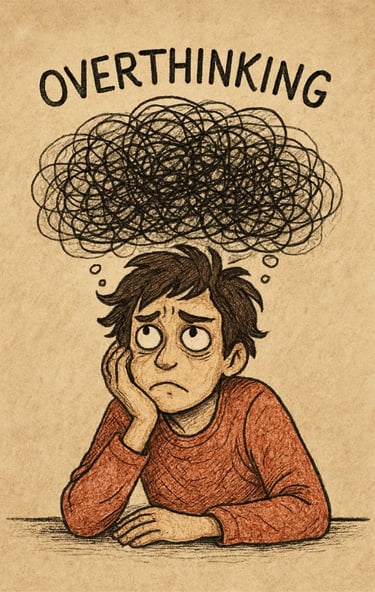
Why Am I Always Overthinking Everything? Causes and Solutions
You send a text and immediately second-guess yourself wondering if it came across wrong. You replay conversations from weeks ago and cringe. You lie awake thinking of every possible way the presentation could go badly tomorrow. Sound familiar? You’re not alone. More importantly, you’re not broken.
Overthinking is one of the most common challenges people go through. And it’s also one of the most misunderstood issues. A lot of us who struggle with overthinking might have been told to “just stop thinking so much”, as if it is that simple. So let’s talk about what’s really going on, why your brain does this, and what can help.
First- What is Overthinking?
Overthinking is not just thinking too much. It’s when your thoughts go around in circles- the same worries and what-ifs without ever reaching an actual useful conclusion.
There are two main types of overthinking. First is ruminating- this happens when you keep replaying the past, wondering about that decision 6 months ago, some cringeworthy thing you said in that meeting or the fight you had with your parents.
The second is worrying- this is when your mind is constantly occupied with thoughts about what the future holds, asking yourself “what if this goes wrong?” or “what if they don’t like me?” or “what if everything falls apart?”
Your brain might try to convince you that either one is “productive”. You might feel like you’re being responsible and careful to think things through. But the reality is- neither ruminating nor worrying actually lead to solutions. They just keep you stuck, and before you know it, the present slips away.
Why Does Your Brain Do This?
The truth is: your brain overthinks because it’s trying to protect you. It’s not that your brain is not working properly- it’s just doing its job.
The part of the brain responsible for detecting threats- “the lizard brain” has evolved to keep us safe from actual physical dangers. The problem arises because in modern life, the brain fails to differentiate between, let's say, a lion chasing you and a difficult text you need to send. So, the brain treats both cases like emergencies, keeping your mind occupied to try to find a way out.
Beyond this, there are a few more psychological reasons some of us are more prone to overthinking than others, especially for those who grew up in India.
Growing up in high-pressure environments. Those who grew up in a household where marks, performance or reputation mattered more than anything else, overthinking might just be a result of the brain being trained to be always alert.
The smallest mistakes are catastrophic. When we grow up in an environment which doesn’t allow us to make mistakes, our brain forms a habit of going over everything again and again before making a decision, and then second guessing after the decision has already been made. The fear of making a wrong decision becomes so loud that it becomes difficult to go on with your life without overthinking everything.
Comparing yourself to others is natural now. Ever wonder why you can never be fully confident in your decisions? Maybe the reason is growing up in an environment where your achievements were never enough compared to that neighbor’s kid next door. Or maybe it’s the social media comparison trap- surrounded by everyone else’s “perfect life” makes us overthink our own choices.
Anxiety. Overthinking and anxiety feed each other. The more anxious you are, the more your mind searches for things to be worried about. The more your mind searches for these things, the more anxious you become. This sounds like a never-ending loop, but it can be broken with the right guidance and support.
What Does It Actually Do to You?
Here’s something you must know: overthinking might feel useful but it actually makes things worse. Research shows that ruminating and spiraling negative thoughts may cause anxiety, depression and emotional exhaustion.
Also, overthinking makes decisions even harder to make, not easier. The more you overthink a decision, the more overwhelming it gets. As a result, a decision which was simple and easy becomes this enormous, life-altering thing with no clear answer. As a result, you either make a rash decision to stop the spiral, or refuse to make the decision entirely.
And then there’s one factor most people fail to consider- sleep. If your mind won’t switch off at night, racing with thoughts about what happened yesterday or what might tomorrow look like- that is not some minor inconvenience. Chronic poor sleep can affect your mood, concentration and in the long run, your physical health too.
What Can Help
Let’s be clear about one thing: telling yourself to “just stop overthinking” does not work. If you try to suppress a thought, it will only become louder. So instead, here are some ways that can actually help with overthinking.
Instead of forcing yourself to never think about something, try having a 15-minute "worry window" in your day where you let yourself think about whatever is stressing you. Outside that time, if the thoughts come, you just need to remind yourself: "I'll deal with this at 6pm."
Ask yourself: is this solvable right now?
When you notice you're spiralling, pause and ask yourself: can I actually do something about this right now? If yes- do that thing. If no- you need to realise that your brain is using energy on something it can't control at this moment.Get out of your head and into your body
Overthinking thrives in the mind. One of the fastest ways to stop or interrupt it is to give your brain some physical activity to focus on like a walk, a cold shower, cooking something, or just focusing on your breathing for two minutes. This way, you're not avoiding your thoughts- you're just giving your nervous system a chance to reset.Write it down
There's a reason journalling is one of the most commonly advised activities in mental health care, because it genuinely helps. When thoughts are in your head, they feel too much and never-ending. Jotting them down on paper makes them seem smaller and hence more manageable. When you journal, you might also come across some patterns in your thoughts that are worth understanding.Talk to someone
Be it a trusted friend, a family member or a therapist- there's something about hearing yourself talk through a problem or having someone gently listening and reflecting on it. This makes the spiral of thoughts lose power. Sometimes the thoughts just need somewhere to go.Try therapy- specifically CBT
Cognitive Behavioural Therapy (CBT) is one of the most well-researched therapy approaches for overthinking and anxiety. It not just about coping techniques- it also helps you understand the patterns underneath your thoughts and how to change them.
When Is It More Than Just Overthinking?
Sometimes constant overthinking is a sign that there is something bigger in our mind which needs attention. If you feel like your thoughts are affecting your day-to-day life, maybe causing problems in relationships or work- then it is time to consider talking to a professional. Not because you have failed at fixing things yourself, but because sometimes your mind is overwhelmed and deserves proper support.
One Last Thing
If you’ve read this far, there is a chance that you really struggle with overthinking. But there is one important thing to remember: this is not a flaw.
It just means that you’re someone who cares deeply about the people around you and about doing things the right way. These are good qualities.
Remember: the goal isn’t to become the kind of person who never thinks twice about anything. It’s to build a healthy relationship with your own mind so that you notice when you start to spiral and gently step out of it.
This is a skill. And like any skill, it will get easier with practice.
The Therapeutic Space © 2025. All rights reserved.
We care deeply for your mental health, but The Therapeutic Space does not provide emergency or crisis support.
If you or someone you know is in immediate danger or requires urgent help, please contact the national mental health helpline at 1800-599-0019, reach out to suicide helplines, or visit your nearest hospital or emergency center for immediate assistance.